
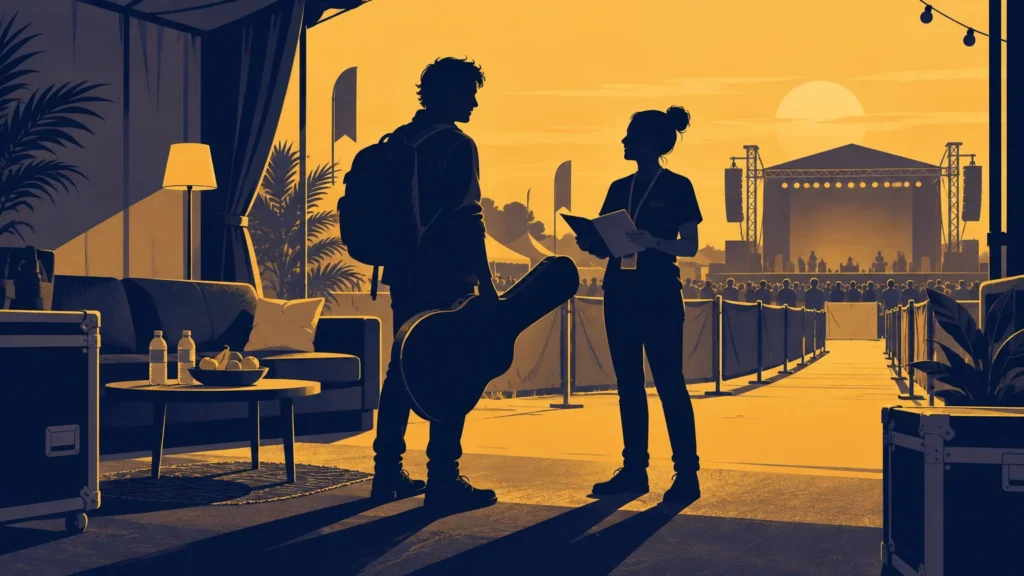
TLDR: A useful festival artist hospitality checklist confirms the current rider, touring-party headcount, dietary and access requirements, transport, credentials, backstage space, water, meal times and show-day contacts before anyone travels. Put every agreed provision and substitution into one current day sheet. On site, assign a reachable artist liaison who can solve problems without sending the touring party through five different departments.
Festival hospitality is performance infrastructure. When it works, artists and crew members know where to enter, who will meet them, when they can eat, where they can rest and how they will reach the stage. That predictability matters at any event, but especially at festivals where several artists, vehicles, production teams and catering schedules converge on one site.
A festival artist hospitality checklist should not become a catalogue of extravagant rider requests. Its purpose is to turn agreed requirements into a realistic care plan. A clean shared room, safe drinking water, a meal served at the right time and an informed liaison will usually be more useful than an impressive promise that disappears on show day.
Hospitality rider, technical rider and festival advance
A hospitality rider covers an artist’s non-technical requirements, while a technical or production rider deals with the equipment and conditions needed to present the show. The MusicNSW hospitality rider template identifies common hospitality areas such as meals, dietary requirements, beverages, dressing-room provisions, towels, mirrors, seating, Wi-Fi, power access and guest-list arrangements.
| Item or role | What it covers | Key question |
|---|---|---|
| Hospitality rider | Meals, drinks, backstage space, comfort and agreed guest arrangements | What does the touring party need away from the stage? |
| Technical rider | Sound, lighting, stage layout, power, backline and production staffing | What is required to perform the show safely and as intended? |
| Festival advance or artist packet | Arrival, schedule, credentials, maps, contacts and confirmed provisions | How will the plan work at this particular event? |
| Artist liaison | Artist-facing communication and coordination on site | Who can answer questions and escalate a problem quickly? |
| Runner | Assigned collections, purchases or transport tasks | Who is completing the specific approved errand? |
These documents and roles overlap, but they are not interchangeable. An artist liaison should understand the hospitality plan without becoming the sole catering manager, driver, credential desk and stage manager. Clear ownership lets the liaison coordinate with the people who can actually fix each issue.
Phase 1: Advance the hospitality plan early
Begin by collecting the current rider rather than relying on one saved from a previous tour. Confirm who has authority to approve changes: this may be the artist, tour manager, road manager or another designated representative. Then identify the festival’s primary and backup contacts.
Production-advance guidance from PRS Foundation recommends collecting artist contacts, riders, catering requirements, venue-facility information and unresolved operational details early. It also highlights the touring-party size, load-in and soundcheck times, performance duration, backline, engineering arrangements and a main day-of contact as points to confirm.
- Collect the current hospitality and technical riders.
- Confirm the total touring party, including artists, crew and drivers where applicable.
- Record arrival method, expected time, vehicle details and onward-travel needs.
- Privately confirm dietary, allergy-related, accessibility and relevant cultural requirements.
- Identify which requests the festival can provide exactly.
- Flag unavailable items and propose practical substitutions before travel.
- Name primary and backup festival contacts, with working phone numbers.
- Set a deadline for final changes and issue a dated, version-controlled day sheet.
The appropriate lead time depends on the event. The research summary of PRS Foundation guidance suggests roughly two to three weeks for grassroots gigs and as much as three months for larger events, but this is planning guidance rather than a universal deadline. International travel, visas, complex ground transport and large touring parties may justify starting earlier.
Artists should also assess what kind of event they are entering. A showcase built around short industry-facing sets may have different backstage capacity and changeover pressure from a ticketed public festival. Our comparison of a showcase festival and a public festival explains why their goals and preparation demands differ.
Phase 2: Make arrival and site movement unambiguous
A general festival address is not an arrival plan. Give the touring party the correct artist entrance, a map pin where useful, parking or drop-off instructions, accreditation steps and the name of the person meeting them. Explain whether instruments must be carried across grass, gravel, stairs or a long distance from the vehicle.
- Artist entrance and exact meeting point
- Vehicle permits, parking location and drop-off restrictions
- Credential collection process and required identification
- Access route to dressing rooms, production areas and the stage
- Realistic walking distance and surface conditions
- Accessible route and assistance arrangements where requested
- Guest-list procedure and the limits of guest access
- Contact to call if the vehicle is delayed or the entrance changes
Credentials require precise language. An artist pass may not grant access to every production area, and a guest wristband may not include backstage entry. Explain access levels before names are submitted so that artists do not make promises the festival cannot honor.
Phase 3: Inspect the backstage hospitality area
Not every artist needs a private dressing room. What matters is that the promised arrangement is accurate and suitable for the touring party. A smaller festival can offer a shared lounge, tent or trailer if controlled access, cleanliness, seating and reasonable privacy have been discussed in advance.
- Clean room, tent, trailer or clearly defined section of a shared lounge
- Enough chairs and usable surfaces for the agreed number of people
- Nearby toilets and handwashing facilities
- Power and charging access appropriate to the site
- Wi-Fi details if internet access was promised
- Mirror, towels or clothing rail where agreed
- Secure or supervised arrangements for personal belongings
- Controlled access that keeps the area from becoming a public thoroughfare
- Ventilation, shade, heating or rain protection appropriate to conditions
- A clearly marked supply of drinking water
Outdoor events also need weather-aware hospitality. Heat, cold, rain and wind can change whether a tent or temporary room remains usable. The Event Safety Alliance weather-preparedness standard supports planning for weather hazards and qualified decision-making, although each festival still needs its own site-specific procedures and emergency instructions.
Phase 4: Coordinate food, hydration and dietary care
Meal timing should follow the artist’s working day, not simply the caterer’s default service window. Check arrival, soundcheck, media commitments, stage call, performance and departure. A meal technically available during soundcheck is not meaningfully available to the musicians on stage.
- Confirm how many full meals and light refreshments are required.
- State the service location and opening times on the day sheet.
- Keep drinking water available from arrival through departure.
- Separate preference, dietary pattern, religious or cultural requirement, and allergy-sensitive need in the planning notes.
- Label meals where feasible and identify the catering contact who can answer ingredient questions.
- Hold special meals separately when agreed so they are not taken by other guests.
- Confirm any after-show meal, drink provision or meal buyout in advance.
- Plan for late arrivals without leaving food at an unsafe temperature.
Treat allergy information as a practical safety matter, not as a casual preference. The FDA explains that food-allergy reactions can be severe and defines allergen cross-contact as the inadvertent introduction of an allergen into food. Its regulatory details are specific to the United States, but its explanation of cross-contact is useful when briefing caterers in any location. Festivals should follow the food-safety rules and professional guidance applicable where the event takes place.
Do not promise that a meal is free from a particular allergen unless the caterer can support that statement. If the festival kitchen cannot manage an allergy-sensitive meal, discuss an appropriate alternative with the artist representative early. That may involve a sealed meal from an agreed provider or another arrangement approved by the relevant parties.
Phase 5: Keep show-day communication on one track
The artist-facing day sheet should summarize what the festival has confirmed, including the schedule, contacts, access information and provision plan. PRS Foundation recommends this kind of summary as the practical record of the advance. It should be concise enough to use from a phone while standing beside a noisy stage.
- Date, festival name and site address
- Artist, tour manager and festival contact numbers
- Arrival, credential collection and vehicle instructions
- Load-in, soundcheck, press, stage-call, set and curfew times
- Performance duration and relevant changeover details
- Dressing-room or hospitality-area location
- Meal location, service times and confirmed dietary arrangements
- Transport schedule and driver contact where applicable
- Guest-list instructions
- Emergency and escalation contacts
- Every agreed substitution or exception
Circulate one current version to artist relations, stage management, security, transport, production and catering. If something changes, update the written schedule and identify what was changed. A message sent only to the artist liaison is not enough when the security gate, driver and stage manager are still working from older information.
On the day, the liaison should check in after arrival, before soundcheck and before stage call. The aim is not constant hovering. It is to remain reachable, notice gaps early and direct each problem to the department able to resolve it.
Minimum viable hospitality for a smaller festival
Limited resources do not excuse vague communication. A small event can provide respectful artist care without pretending to offer an arena-level setup. The minimum workable plan is a clean shared rest area, safe water, reliable meal timing, clear access instructions, a reachable liaison and an honest account of what the site can provide.
If artists will share a room, say so. If showers, Wi-Fi or secure storage are unavailable, disclose that before travel. If catering closes early, arrange the meal around the confirmed schedule or agree on an alternative. Modest hospitality delivered reliably builds more trust than an ambitious rider response that collapses at arrival.
What to do when a request cannot be fulfilled
- Flag the problem as soon as it becomes known.
- Explain the operational constraint clearly and without ridiculing the request.
- Offer a realistic substitute that serves the underlying need.
- Ask the authorized artist representative to approve the change in writing.
- Add the final arrangement to the current day sheet.
- Brief every department responsible for delivering the substitute.
Try to understand the function behind a request. A private room may be intended for changing clothes, vocal rest, prayer, medication or a confidential call. If the festival cannot supply that exact room, knowing the purpose makes it easier to propose a respectful alternative. Sensitive personal details should be shared only with staff who need them to provide the agreed support.
Phase 6: Plan departure and record what happened
Hospitality does not finish at the last note. Confirm the route back to the vehicle, onward transport time, driver contact and any agreed post-set food. Recover temporary credentials or keys without delaying departure, and check that instruments and personal belongings have not been left in the hospitality area.
Afterward, record the useful operational facts: which substitutions were accepted, whether meals matched the schedule, where access became confusing and which fixes worked. Keep the notes factual. They can improve the next advance without turning an artist’s private requirements into backstage gossip.
Final festival artist hospitality checklist
- Current rider reviewed against the agreed plan
- Primary and backup contacts tested
- Touring-party headcount confirmed
- Dietary, allergy-sensitive and access arrangements verified
- Arrival route, parking and transport confirmed
- Credentials prepared and access levels explained
- Hospitality area inspected before arrival
- Special meals identified and protected
- Drinking water placed and replenishment assigned
- One current schedule shared across departments
- Artist liaison and escalation contact on duty
- Departure support and onward transport confirmed
The best next step is simple: run this sign-off with the artist representative and each responsible festival department before the touring party begins its journey. Good hospitality is not spectacle. It is the quiet work of making a complicated performance day feel clear, humane and ready for music.