
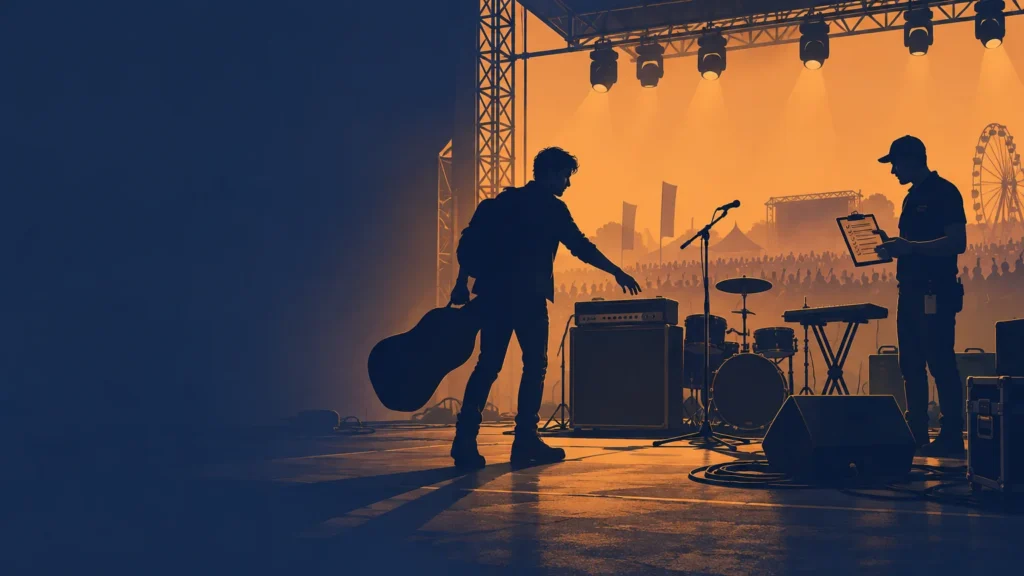
The safest way to approach a festival backline you did not choose is to separate what shapes your performance from what can be substituted. Confirm the supplied equipment in writing, identify the components you must carry, rehearse with the approved alternatives and arrive ready for a line check rather than expecting a leisurely soundcheck.
Backline includes the performance equipment on or immediately around the stage: drum kits and hardware, amplifiers, keyboards, stands, pedals, percussion, DI boxes, stools and related accessories. At a festival, those items are tied to the stage layout, audio patch, monitor plan and tightly timed changeover. A vague request such as “standard drum kit” or “keyboard provided” does not describe a playable system.
TLDR
- Send a current technical rider, stage plot and input list with matching dates.
- Mark every item as artist-carried, festival-supplied, shared or still awaiting confirmation.
- Define acceptable substitutions before travel instead of negotiating them beside the stage.
- Carry the small personal components that most strongly affect feel, tuning, programming or control.
- Ask whether you will receive a soundcheck or only a line check during the changeover.
- Give one band member or crew representative authority to make technical decisions on site.
- Never improvise around wet power, unsafe cabling, blocked exits or unstable equipment.
Start with the music, not the model number
An unfamiliar instrument is not automatically a bad instrument. The real question is whether it can deliver the musical function your arrangement requires. A guitarist who needs a clean platform for a pedalboard has a different problem from one whose entire sound depends on switching channels on a particular amplifier head. A keyboard player using internal festival-piano sounds has different risks from one carrying a programmed controller, laptop and audio interface.
Make a short list of non-negotiable functions for every position. Think about tuning range, number of keys, weighted or synth action, amplifier power, speaker configuration, stereo outputs, pedal response, stand height and the space required to play safely. Then distinguish those functions from preferences. The finish on a drum shell may be flexible; the number and size of toms may not be. A comparable bass cabinet may work; an incompatible impedance or missing footswitch may not.
This is especially important when the arrangement combines instruments with very different setup needs. A nyatiti, electronic keyboard, hand percussion and electric rhythm section cannot be reduced to four instrument names on a rider. Each position needs its own placement, amplification, connections and handling plan. Readers interested in how traditional and contemporary textures can meet within one band can explore the role of nyatiti, orutu and benga in a modern sound palette.
Make three documents tell the same story
Your technical rider states requirements and responsibilities. Your stage plot shows where performers and equipment belong. Your input list tells the audio team what enters the sound system and how it should be patched. Those documents must agree. A revised stereo keyboard setup is not useful if the input list still shows one mono channel, or if the stage plot places its DI boxes on the opposite side of the stage.
Put a version date on every document and include the confirmed lineup, show time, changeover duration, monitor requirements, power needs, artist-carried equipment and festival-supplied equipment. Name the artist contact and festival technical contact. Most importantly, state who may approve a substitution. Matching dates help stop a new equipment request from being paired with an obsolete plot.
The NAMM guidance on festival stage plots and technical riders is a useful external reference when rebuilding an unclear technical package. Keep the finished documents concise enough for a stage crew to understand under pressure.
Build a substitution table before you travel
Do not wait for the festival to say that your first choice is unavailable. Give the production team a controlled path from preferred equipment to acceptable alternatives. Explain the functional requirement when a model cannot be replaced freely.
| Position | Confirm with the festival | Usually worth carrying |
|---|---|---|
| Drums | Shell sizes, tom layout, heads, stands, throne, pedal and riser | Cymbals, snare, preferred pedal, sticks and small spares |
| Guitar or bass | Amplifier head, cabinet, speaker configuration, switching and power | Pedalboard, power supply, footswitches, essential adapters |
| Keyboards | Model, key count, action, stand tiers, stool and outputs | Programmed devices, pedals, controller, interface and backups |
| Percussion | Instrument models, mounts, table, microphones and placement | Specialist instruments, beaters, straps and unique mounting parts |
| Playback or electronics | DI channels, mono or stereo routing, power and device position | Laptop or player, interface, cables and duplicated show files |
A headline item is rarely the complete system. “Two keyboards” leaves unanswered questions about stand tiers, sustain and expression pedals, seating, power supplies, device holders, DI boxes and output channels. “Guitar amplifier” says nothing about the head-and-cabinet pairing, switching system or whether the artist expects to connect a pedalboard to the front input or an effects loop.
Carry the small things that protect the performance
Shared drum shells, risers, cabinets and utility stands can reduce transport and speed up a multi-act day. Personal components are harder to substitute because musicians feel and operate them directly. Cymbals, snares, pedals, programmed keyboards, amplifier heads, footswitches and pedalboards often belong in the artist-carried category when the show depends on them.
Your travel kit should also cover inexpensive failure points: tested signal cables, power supplies rated for the equipment, plug adapters appropriate to the destination, batteries, drum keys, spare strings, fuses where suitable, gaffer tape, hook-and-loop ties and clearly labeled USB media. Carry only what you understand and can connect safely. A random bag of adapters is not a substitute for confirming voltage, connector and power requirements with production.
Label every case and loose component with the artist, position and stage side. Keep a compact inventory on your phone and inside the main case. If another person collects equipment after the set, they should be able to distinguish your sustain pedal or DI box from an identical festival unit.
Rehearse the approved compromise
Once the festival confirms the backline, reproduce the important differences in rehearsal. If the supplied drum kit has fewer toms, decide which parts move or disappear. If the keyboard has a different action, practise the most exposed passages on something comparable. If an amplifier substitution changes gain structure, rebuild the level relationship between patches rather than hoping the engineer can repair it at front of house.
The point is not to make every borrowed instrument feel like home. It is to prevent surprise from entering the arrangement. Agree on musical fallbacks: a mono keyboard feed if one DI channel fails, a clean amplifier setting if channel switching is unavailable, or a simplified percussion setup if the planned mounting hardware does not arrive.
Plan the changeover as a performance task
A stage plot describes the final setup. A changeover plan describes how you get there: what stays on stage, what leaves, what enters, where equipment waits and who verifies each connection. Safe offstage preparation can move stand adjustment, cymbal assembly, pedalboard power checks and amplifier pairing out of the short changeover window.
- Before the previous act finishes, check in with the stage manager and locate your prepared equipment.
- Place artist-carried gear only in the designated holding area, not in access routes or exits.
- Assign each musician or technician a specific move rather than letting everyone reach for the same case.
- Build and connect in the sequence agreed with the stage and audio crews.
- Confirm power, signal and physical stability before switching equipment on.
- Run the line check in input-list order and play short, useful signals.
- Resolve essential faults first; leave cosmetic adjustments until the complete signal path works.
The stage manager normally protects the schedule and coordinates the changeover. Follow that chain of command. One calm artist representative should communicate missing items and approve fallbacks while the musicians prepare to play. Festival delays can affect every artist later in the programme, so a five-person debate over an acceptable stool is not harmless.
Know what a line check can and cannot do
Do not assume that a festival booking includes a full soundcheck. Multi-act events may provide only a line check during the changeover unless a separate soundcheck was agreed during the advance. Festival infrastructure and technical capacity also vary by site.
A line check confirms that the connected performance path works: the expected input reaches the console, routing is correct and the monitor path is available. It is not the ideal moment to discover that a keyboard needs an unavailable power supply, a pedalboard has no output or a drum rack cannot be assembled.
Prepare a short check routine. Each musician should know what to play, which monitor request matters first and when to stop. Begin with “Can you confirm my vocal is in monitor two?” rather than “It sounds strange.” Specific language helps the engineer act quickly.
Treat outdoor stages as changing environments
Outdoor production adds ground conditions, weather, temporary structures, vehicle movement and pedestrian access to the technical picture. Electrical equipment needs protection appropriate to the conditions, while cable routes should reduce trip and mechanical hazards.
Do not place cases in fire exits, protected crew routes or exposed areas merely because they are close to the stage. Do not reconnect wet electrical equipment or bypass a safety decision to save the set time. Requirements differ between countries and local authorities, but weather-rated equipment and proper protection are production responsibilities, not optional refinements. U.S. rules, for example, require suitable receptacles and enclosures in outdoor or damp locations and identify wet cord connectors as a leakage hazard.
Your final pre-departure check
Seventy-two hours before travel, ask production to confirm the latest rider version, supplied models, approved substitutions, stage side, set and changeover times, soundcheck or line-check arrangement, power, monitoring and the person meeting the artist at the stage. Flag unresolved items in one message rather than scattering them across several chats.
Technical preparation belongs beside the wider travel plan. Instruments may be ready while airport transfers, meals or backstage access remain unclear, so coordinate this work with a broader festival artist hospitality checklist. If the event serves industry delegates as well as a public crowd, the performance pressure may also change; our comparison of showcase and public festivals explains why.
A shared backline works when nobody treats “provided” as meaning “understood.” Document the complete system, carry the components that preserve your touch and programming, rehearse the permitted alternatives and give the stage crew a clean changeover plan. Then the unfamiliar kit becomes a manageable instrument for the set—not a mystery waiting under the lights.
References
- Backline Requirements Checklist | Technical Rider Guide
- GUIDE: Advance og festival | Musikkontoret
- Festival Stage Plot: Tech Rider Update | NAMM.org
- Festival Backline and Artist Changeovers
- APF26 Artist Info – Afro Park Fest
- Venue and site design – HSE
- Electrical safety – HSE
- 1910.305 – Wiring methods, components, and equipment for general use. | Occupational Safety and Health Administration