
TLDR
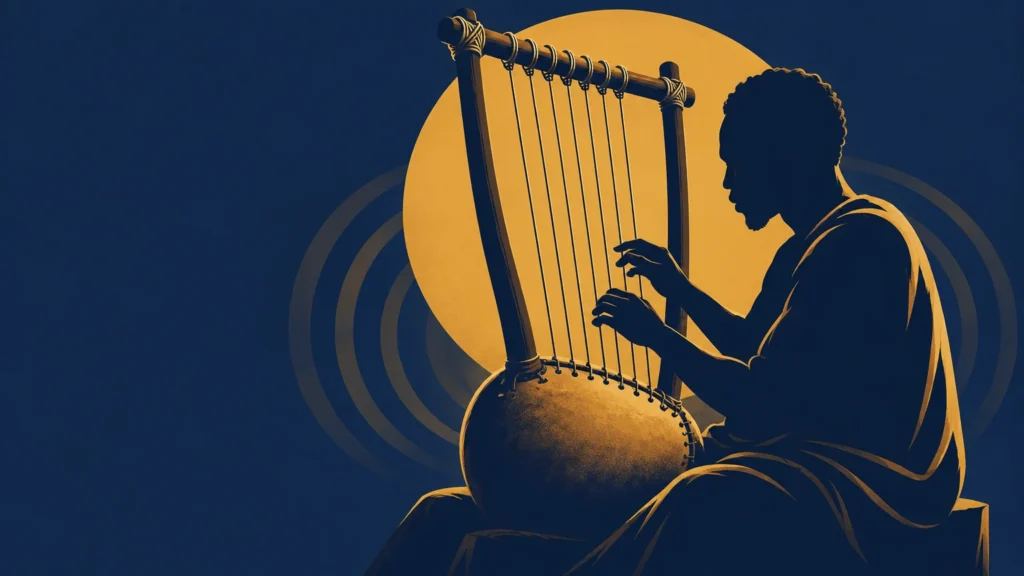
The essential nyatiti instrument basics begin with an eight-stringed instrument associated with Luo music in Kenya. Its bowl-shaped, hide-covered resonator supports a wooden frame, crossbar, bridge, and strings. A seated player can use both hands to create repeating and contrasting figures while singing and, in some performances, adding ankle-bell and toe-ring percussion. There is no single tuning that should be treated as universal: tuning can vary with the player, instrument, repertoire, and teaching lineage.
Understanding the nyatiti means listening to more than eight separate notes. The instrument often works as the rhythmic and melodic foundation of a complete performance. Pulse, repetition, variation, voice, and movement meet around one performer, making a compact instrument sound remarkably expansive.
Nyatiti instrument basics: what is it?
The nyatiti is an eight-stringed Kenyan instrument closely associated with Luo musical culture. It is commonly described as a lyre, although the National Museums of Kenya calls it a “plucked bowl-yoke lute.” Its overview of Luo music and instruments places the nyatiti within a wider musical world that also includes percussion, rattles, horns, and other string instruments. Luo music accompanies important social occasions rather than existing only as an isolated concert form.
For a beginner, “eight-stringed Luo lyre” is a useful description. It identifies the instrument’s structure and cultural association without pretending that one English classification settles every question. “Lyre” and “lute” are sometimes applied differently by museums, performers, and scholars. The word thum also appears in Luo lyre terminology, although its meaning and use are best understood within the particular musical and linguistic context rather than treated as a simple product label.
A nyatiti is not simply a small harp, nor is it an acoustic guitar with fewer strings. Those comparisons may help a new listener picture plucked strings, but they obscure the instrument’s frame, playing position, tuning practices, and relationship between instrumental pattern, song, and bodily rhythm.
The shape and main parts of a nyatiti
Documented examples share a recognizable design: a bowl-shaped resonating body covered with hide, a wooden frame and crossbar, strings, and a bridge. Individual instruments can differ because they are made, maintained, and adapted by particular makers and musicians. Contemporary examples may use nylon strings, so the material should not be assumed merely from an instrument’s traditional appearance.
| Part | Basic role | What to notice |
|---|---|---|
| Bowl resonator | Forms the main sound chamber | Its rounded body helps distinguish the nyatiti’s silhouette. |
| Hide covering | Stretches across the resonator | It provides the vibrating surface supporting the bridge. |
| Wooden frame | Rises from and spans the body | It gives the instrument its open, framed shape. |
| Crossbar | Supports the upper ends of the strings | The strings extend between the body area and this upper structure. |
| Bridge | Transfers string vibration toward the resonating surface | Its position connects plucked-string movement to the body. |
| Eight strings | Supply the instrument’s pitches and repeating figures | Their material, tension, spacing, and tuning can vary between instruments and players. |
The eight strings are central, but the nyatiti’s identity does not come from string count alone. The relationship between the strings, bridge, hide surface, and resonating bowl shapes the response of the instrument. The open frame also contributes to a playing posture quite different from holding a guitar against the chest.
How is a nyatiti held and played?
In a documented playing approach, the musician sits with the strings facing the body and plucks with both hands. Anyango’s first-person artist profile describes combining the instrument with singing and, where used, percussion produced by ankle bells and a toe ring. This creates a coordinated performance in which the hands, voice, foot, and leg can each contribute a distinct layer.
The two hands need not behave like mirror images. One can maintain a grounding pulse or recurring figure while the other picks out movement around it. The player may then shape the vocal line across that foundation. In some setups, the ankle bells are called gara, while a toe-ring percussion device is known as oduongo. These additions are documented features, not compulsory equipment for every nyatiti player or every song.
This distinction matters because an instrument guide can easily turn one photographed setup into a rigid rule. Nyatiti performance is better understood as a living practice with recognizable principles and room for individual technique. Posture, string material, rhythmic emphasis, vocal delivery, and accompanying percussion can all reflect the musician and context.
Why one player can sound like several musicians
A useful listening term here is ostinato: a musical figure that repeats. Repetition does not mean that nothing changes. A recurring figure can establish the cycle while accents shift, another string pattern enters, the voice stretches across the beat, or percussion marks a separate pulse.
Imagine a short string figure going around like a wheel. On the next turn, the player emphasizes a different note. A sung phrase begins before the cycle feels complete and resolves after it starts again. Bells add a bright pattern above the strings, while the toe rhythm provides a contrasting attack below them. Each part may be economical on its own, but their alignment creates density.
That density is one reason a first-time listener should resist translating the performance immediately into guitar chords. Chord names may describe selected pitch combinations, but they can miss the more important musical question: how does the repeating cycle support the voice, and what changes from one repetition to the next?
How is the nyatiti tuned?
There is no responsible single-note answer for every nyatiti. Washington A. Omondi’s doctoral research on traditional Luo lyre music addresses tuning alongside manufacture, accompaniment patterns, song texts, and vocal material, showing that tuning belongs within a broader performance system rather than being an isolated specification. Readers interested in that depth can consult the University of Nairobi record for Traditional Lyre Music of the Luo People of Kenya.
A tuning may depend on the instrument’s construction, the player’s voice, the song, the desired relationships between strings, and the lineage through which the musician learned. Consequently, one online tuning chart should not automatically be treated as the standard for every instrument.
For beginners, it is more useful to hear the relationships between strings than to chase a supposedly definitive set of Western note names. Listen for the lowest-feeling pulse, recurring pairs or groups of pitches, notes that answer the vocal line, and tones that create tension before returning to the main pattern.
If you have access to a physical nyatiti, learn its tuning from its maker, teacher, or player before changing string tension. Do not assume that guitar intervals, guitar strings, or guitar tuning procedures transfer directly. The safest learning sequence is to document the instrument’s current sound, identify how its strings are ordered, and make any adjustment under knowledgeable guidance.
The nyatiti in Luo musical life
The nyatiti belongs to Luo musical history, but it should not be spoken about as an artifact sealed in the past. Museum accounts place instrumental music within social occasions, while contemporary fieldwork in Siaya County has documented conversations with active nyatiti players and makers about transmission and instrument-making. The instrument continues through performance, teaching, construction, experimentation, and public presentation.
Its public history also calls for careful language around gender. Smithsonian Folklife Festival material describes Suzanna Owiyo as being among the first Kenyan women to play the nyatiti publicly. That specific wording is more useful than a sweeping claim that women were universally forbidden to play it across every place and period.
Listeners who want to hear how the nyatiti can sit inside a contemporary artist’s wider sound can continue with Nyatiti, Orutu, and Benga in Suzanna Owiyo’s music. The broader lesson is not that modern presentation replaces tradition. It is that musicians continually make choices about arrangement, amplification, ensemble texture, and audience while carrying recognizable instrumental knowledge forward.
A short listening route
Start with a complete performance rather than a short demonstration of isolated strings. A full song reveals how the cycle supports voice, pacing, text, and variation.
- Listen to Ayub Ogada. Smithsonian presented him in its 2014 Kenya program as a master of the eight-string plucked instrument. Focus first on the steadiness and space around the repeating pattern rather than trying to name every pitch.
- Listen to Suzanna Owiyo. Pay attention to how nyatiti color and Luo-rooted musical ideas can work within a broader contemporary performance identity. Smithsonian’s account of her public importance also provides valuable context for women’s visibility around the instrument.
- Watch Anyango perform or explain her setup. Her profile is especially useful for noticing the coordination of two-handed playing, singing, ankle bells, and toe percussion.
- Return to the first performance with headphones. Follow only one layer at a time: recurring strings, melodic movement, voice, and then any foot or ankle percussion.
A first-listen checklist
You do not need formal training to hear the structure. On the first pass, let the entire performance settle. On the second, use this checklist:
- Find the pulse. Which sound makes the musical cycle feel grounded?
- Identify the recurring figure. How long does it take before the pattern seems to return?
- Notice the moving notes. Which pitches decorate, answer, or interrupt the recurring figure?
- Follow the voice. Does the sung phrase begin and end with the instrumental cycle, or stretch across it?
- Listen for percussion. Are bells or toe-produced sounds present, and do they reinforce or contrast with the strings?
- Track small changes. Notice accents, omitted notes, altered attacks, pauses, and changes in vocal intensity.
- Listen to the space. The gaps between plucks can be as important as the notes themselves.
Nyatiti and orutu are not the same instrument
The names sometimes appear together in discussions of Luo and Kenyan music, but they should not be used interchangeably. The nyatiti is an eight-stringed plucked instrument with a bowl resonator and frame. The orutu belongs to a different bowed-string tradition and calls for a different playing motion and sound-production technique. Hearing both in related musical settings does not make them versions of the same object.
The most useful next step
Begin with one complete nyatiti performance and hear it without trying to translate it. Then play it again and follow the recurring string pattern. On a third listen, concentrate on the voice and any ankle or toe percussion. That sequence turns the instrument from an unfamiliar shape into an intelligible musical system.
Once you can hear the cycle, the nyatiti’s eight strings stop looking like a technical puzzle. They become part of a coordinated practice: a resonating body, two active hands, a singing voice, and sometimes moving feet producing several musical roles at once. That layered relationship—not a universal tuning chart—is the strongest foundation for understanding the instrument.
References
- Music of the Luo — Google Arts & Culture
- Traditional lyre music of the Luo people of Kenya
- PROFILE | Anyango Official Web Site
- A Musical Review: Instruments of the Folklife Festival | Smithsonian Folklife Festival
- Day 4 – Tuesday 4th July 2017 | Singing Wells
- Groundbreaking Women of the Folklife Festival: 'That Was Then, This Is Now' | Smithsonian Folklife Festival
- Job Ouko Seda (Ayub Ogada) | Smithsonian Folklife Festival