
TLDR
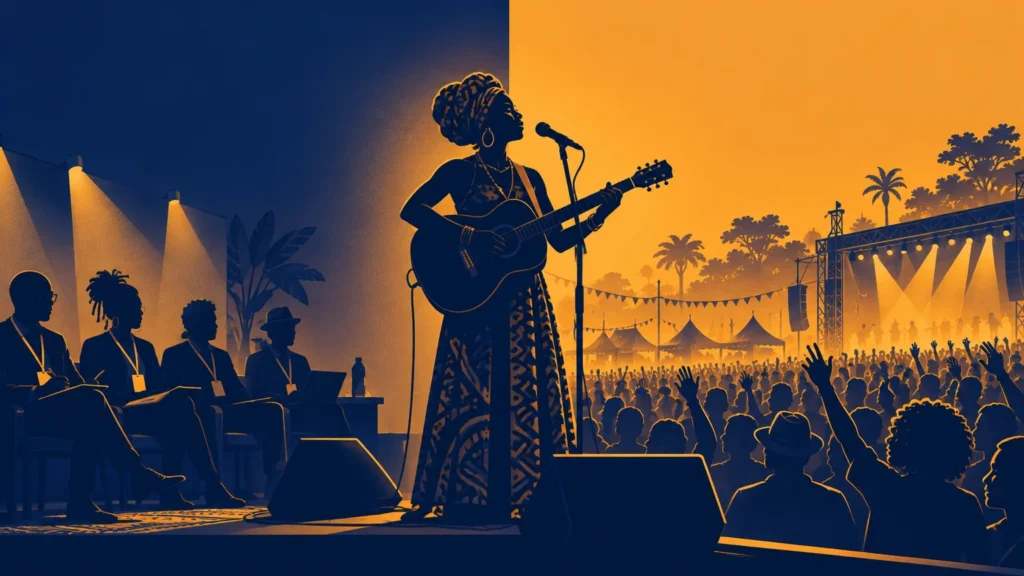
The simplest answer to showcase vs public music festival is that the formats have different primary goals. A showcase concentrates attention on artists who want to be discovered by bookers, presenters, media, potential collaborators and curious fans. A public festival is chiefly designed as a shared cultural experience for its audience. The categories overlap: a large festival may contain official showcase stages, while an industry conference may open its evening performances to the public.
For artists, the event name matters less than the room, the terms and the purpose. Before accepting a slot, find out who will attend, whether the performance is part of the official program, what the organizer will provide and how success should be measured. A packed public field and a small room containing relevant programmers can both be valuable, but they ask for different preparation.
What is a music showcase?
A music showcase is a performance organized around discovery and concentrated visibility. The set may be part of a conference, a festival, a label presentation, an export program or a promoter-curated night. Fans can attend, but the room may also include festival programmers, venue buyers, journalists, managers, agents, publishers and other musicians.
There is no single universal showcase format. One event may offer a short official slot on a tightly managed multi-artist bill. Another may use “showcase” as a loose description for a local discovery night. The word alone does not tell an artist whether travel is covered, credentials are included, delegates are expected, the show is ticketed or payment is available.
A showcase is therefore not automatically a career-changing opportunity. It creates a setting in which useful people may hear an artist, but it cannot guarantee bookings, press, management or a recording deal. Its practical value depends on the event’s credibility, the fit between artist and audience, and the work done before and after the performance.
What makes a public music festival different?
A public music festival is primarily an audience-facing occasion. It brings people together around music, place, identity, celebration or a wider cultural theme. UNESCO’s discussion of festival concepts and cultural statistics describes festivals as themed public celebrations, a useful frame for understanding why atmosphere, community and the total program matter alongside individual performances.
That does not mean public festivals lack professional activity. Bookers watch artists at festivals, journalists cover them and musicians meet future collaborators backstage. The distinction is one of emphasis rather than a locked gate: the audience experience usually sits at the center, while professional discovery may happen around it.
Public festival sets may also give artists more room to build an emotional arc. Depending on the program, there may be time to introduce songs, stretch an instrumental passage or invite a crowd into a call-and-response. A showcase often demands a more compressed statement: fewer songs, faster changeovers and less time to recover from an unfocused opening.
Showcase vs public music festival at a glance
| Question | Showcase | Public festival |
|---|---|---|
| What is the primary purpose? | Artist discovery, professional visibility and focused presentation | A shared live-music or cultural experience for a broad audience |
| Who may be in the crowd? | Fans, delegates, bookers, media, managers, peers and invited guests | Ticket holders, local audiences, visitors, families or genre communities, depending on the event |
| How is the program shaped? | Often a curated multi-artist bill with concentrated or shorter sets | Often multiple stages, longer programming and wider audience activities |
| What should the artist emphasize? | A clear identity, immediate impact, punctuality and an easy follow-up path | Audience connection, pacing, stagecraft and a set suited to the time and setting |
| How might success be assessed? | Relevant conversations, qualified contacts, follow-up invitations and stronger professional relationships | Audience response, fan growth, merchandise activity, repeat invitations and the quality of the live connection |
| Are payment and travel included? | Depends entirely on the event’s written policy or offer | Also event-specific; the festival label does not guarantee particular terms |
Hybrid events make the labels less tidy
Some of the most useful examples combine both models. SXSW distinguishes its wider Music Festival from official showcase performances within that festival. Its artist materials describe an application as a request to be considered for an official showcase slot. The result is both a public live-music program and a professional discovery environment rather than a choice between two completely separate worlds.
The Music In Africa Foundation’s ACCES model offers an African example of this overlap. Organizer materials describe a program combining an industry conference, workshops and networking with curated live performances. They also distinguish conference activity from live Industry Nights, with participation extending across music professionals and audiences.
These hybrids explain why artists should read the program rather than rely on the poster. A performance listed within a conference may still attract an enthusiastic public audience. A slot at a public festival may sit on a stage specifically curated for export-ready or emerging talent. Ask which part of the event you are joining and who is expected to be there.
How artists should prepare for a showcase set
A good showcase set is not simply a normal headline show made shorter. It is a concise introduction to the artist’s musical identity. The first song should establish something recognizable quickly: the voice, rhythmic language, instrumental color, lyrical point of view or stage presence that makes the act worth remembering.
This does not require sanding away cultural or musical complexity. A Kenyan group working with nyatiti, guitar and electronic textures, for example, should not flatten that language into a generic festival sound. The task is to present its character clearly. Choose songs that reveal the musical relationship among the performers without demanding a long explanation before the audience can enter the music.
- Confirm the exact set length and design a set that finishes early enough to absorb applause, tuning or a brief technical interruption.
- Open with a strong, representative song rather than a slow warm-up that assumes an hour-long concert.
- Keep spoken introductions concise, but give enough context for unfamiliar listeners to understand the music.
- Rehearse entrances, endings and transitions. Dead air feels longer in a short set.
- Prepare a current electronic press kit containing a concise biography, strong photographs, live video, release links, contact details and accurate credits.
- Give interested listeners and professionals one simple next step. A memorable URL, mailing-list prompt or thoughtfully placed QR link is better than five competing calls to action. See this practical guide to using QR code stickers at live shows.
- Record every meaningful contact with a note about what was discussed, then follow up personally after the event.
Professional preparation also includes restraint. Do not spend the entire set asking industry delegates to notice you. Play for everyone in the room. The most convincing introduction is usually a coherent performance, not a speech about future potential.
How preparation changes for a public festival
At a public festival, the artist must think beyond introduction and toward collective experience. Sightlines may be wider, distractions greater and many listeners may have arrived for another act. Song pacing, physical communication and clear stage sound become especially important.
Build the set around the likely audience and time of day. An afternoon community crowd may respond differently from a late-night genre audience, but neither should be treated as passive. Plan how the set will gather attention, where it will breathe and what final impression it should leave. If the festival attracts listeners eager to explore regional scenes, context can deepen the encounter; readers can similarly continue discovering artists and musical currents from Western Kenya.
Merchandise and audience capture may matter more at a public event because the artist can reach many listeners at once. Still, every request should feel proportionate. Make it easy to find the music after the show without turning the performance into a long advertisement.
What to ask before accepting a showcase invitation
Treat an invitation as a proposed working arrangement, not proof of prestige. A credible organizer should be able to explain the event, the status of the performance and the terms applying to artists.
- Who is the organizer, curator and contracting party?
- Is this an official program slot, a partner event or an unofficial performance using the larger event’s name?
- Who can enter the venue: accredited delegates, invited guests, ticket buyers or the general public?
- Is there a performance fee, credential, per diem or other compensation? When and how is it provided?
- Who pays for visas, travel, accommodation, local transport, freight and meals?
- What backline, microphones, monitoring, stage time and soundcheck are available?
- Who owns or may use photographs, audio, livestreams and performance recordings?
- Are there radius, exclusivity or conflicting-performance restrictions?
- Will the organizer provide a delegate directory, networking sessions or a method for requesting meetings?
- What happens if the schedule changes or the event is cancelled?
Payment should never be assumed in either format. SXSW, for example, publishes a specific payment and credential policy for its showcasing artists, illustrating that compensation and access are governed by individual event rules rather than a universal showcase standard. Read the current terms for the edition you are considering and obtain the relevant promises in writing.
Be particularly cautious when someone demands money while implying that payment guarantees an official slot or access to decision-makers. SXSW has publicly warned artists about pay-to-play scams associated with supposed showcase opportunities. Verify offers through the event’s official contact channels, inspect the contract and do not let urgency replace due diligence.
How should an artist measure success?
The wrong measurement can make a useful appearance look like a failure—or make an expensive, unfocused trip look impressive. At a showcase, raw crowd size may matter less than relevance. Three serious conversations with suitable presenters can be more valuable than collecting dozens of contacts who have no connection to the artist’s goals.
Before travelling, choose a small set of outcomes that the event can realistically influence. These might include meeting programmers from particular regions, presenting a new live configuration, starting conversations about a future tour, finding collaborators or learning how international delegates respond to the set. These are objectives, not promised results.
For a public festival, useful indicators may include audience engagement, merchandise activity, mailing-list sign-ups, post-show listening and whether the performance deepened the artist’s relationship with a place or community. Numbers need context: a modest audience in a new market may represent meaningful progress, while a large crowd may produce little lasting connection if nobody can find the artist afterward.
What the distinction means for listeners
Showcases reward curiosity. Sets can be brief, schedules dense and some performers unfamiliar, so the pleasure comes from hearing an artistic idea at the moment it is being introduced to a wider network. Moving between rooms or stages is part of the experience.
Public festivals more often foreground the whole occasion: gathering with friends, spending time in a particular place, seeing favorite performers and encountering food, art or other cultural programming around the music. Discovery still happens, but it sits within a larger social experience.
To tell what kind of event you are considering, inspect the schedule and access information. Frequent short sets, conference sessions, delegate registration and formal networking suggest a showcase-led model. Major public stages, day passes and broad cultural programming point toward a public festival. When both appear, the event is probably a hybrid.
Choose by purpose and terms, not the label
The showcase vs public music festival distinction is best understood through primary purpose. A showcase concentrates discovery and professional attention; a public festival organizes a broader shared occasion. Neither format is inherently more prestigious, artist-friendly or valuable.
Artists should begin with two questions: “Who is this performance for?” and “What exactly is being offered?” Then verify the audience, official status, production, compensation, travel responsibilities, rights and follow-up access. Once those answers are clear, build the set for the room you will actually enter—not for the promise suggested by one word on a poster.